AI for Sales Prospecting: What It Does Well, and What It Wrecks
Where AI genuinely helps in sales prospecting (research, list building, signal detection) and where it quietly destroys reply rates, with a clear line drawn between the two.

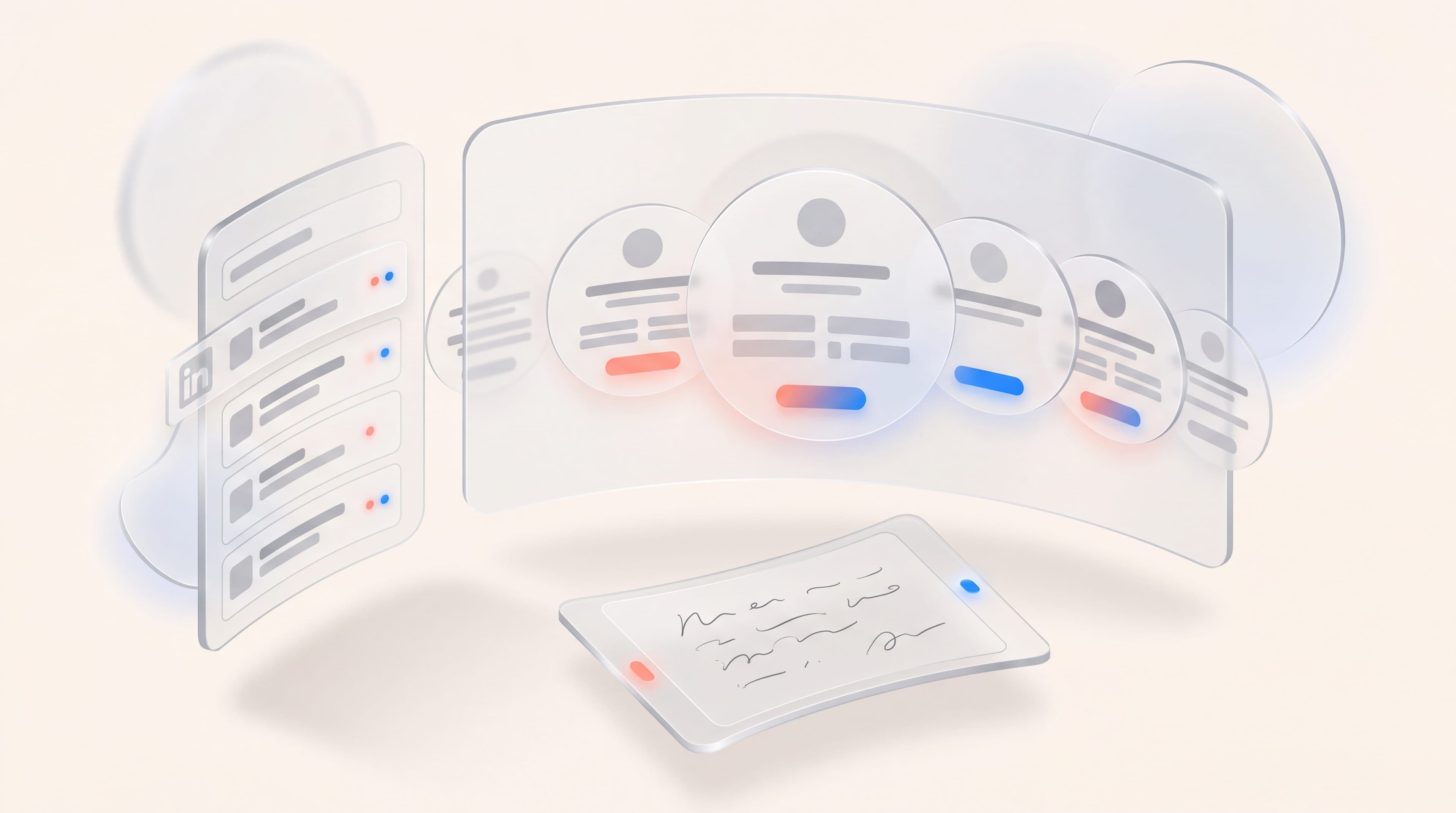
Nearly every prospecting product sold to a B2B company this year has AI somewhere in its name, and the pitch for AI for sales prospecting barely varies: more prospects, more personalization, less human time. Plenty of the companies that bought in are now sending several times the volume they sent a year ago and booking fewer conversations. More sending, fewer meetings. That pairing is the single most common pattern I find when I look inside an underperforming prospecting function.
I am Sky Jordan, a consultant at Moriah, a LinkedIn Certified Marketing Partner. We work with established B2B companies to turn LinkedIn into a real business engine, running executive personal branding, targeted outreach and LinkedIn Ads together rather than as three separate projects. Prospecting tends to be the first place AI shows up inside a company, usually without much thought about which half of the job it has just been handed.
So this page is about the line. Using AI for sales prospecting is not good or bad as a whole. It is excellent at a few specific jobs and genuinely destructive at one, and the difference between the companies getting value and the companies burning their market is whether they know which is which. I will be specific about where I think that line sits, and honest about the failure mode, which is volume without relevance.
The two halves of prospecting, and only one of them is a writing job
Prospecting splits cleanly in two.
The first half is deciding who to contact and why now. Reading the account, understanding the person, working out what changed recently that makes this a sensible week to appear in their inbox. Research work, and mostly invisible.
The second half is the contact itself. The message a human being reads and decides, in about four seconds, whether to answer.
AI is very good at the first half. It is bad at the second, and not in a way a better prompt fixes. Almost every disappointing AI prospecting program I have reviewed made the same mistake: it automated the visible half, the writing, and left the invisible half exactly as underdone as it was before.
What AI for sales prospecting is genuinely good at
Research that otherwise never gets done
Before contacting a director at a logistics company, somebody should have read their recent posts, the company's last few announcements, the roles they are hiring for and what their competitors are saying. In practice nobody does. It is twenty minutes per prospect and there are four hundred prospects.
AI collapses that into something closer to a minute. The real gain is not the time saved, though. It is that the research happens at all. A team that has never had researched prospects suddenly has them, and everything downstream improves: targeting, timing, qualification, the first call.
Building a list from a description instead of a filter
Traditional list building is filter work. Job title contains "Operations Director", company size in a range, industry equals manufacturing. You get a list that matches the filters and misses the point, because what you actually wanted was "companies that ship physical goods across borders and have recently started selling direct".
AI handles description-shaped criteria that filters cannot express. That is a real capability, and it is underused.
One rule though, and it is not optional. Before anything gets sent, a person reads a sample of twenty rows and checks them against the source. AI infers, and inference produces confident membership in a list a company does not belong in. Twenty rows takes ten minutes and catches the systematic errors, which are the only ones that matter at volume.
Signal detection, which is where AI earns its keep
If I could keep only one use of AI in prospecting, it would be this one. Watching a defined set of accounts for change: a new executive in a relevant seat, a new site or market, a hiring pattern that implies a project, a post where someone describes a problem you solve.
Timing beats wording by a wide margin. An ordinary message sent the week something changed will outperform a beautifully crafted message sent for no reason at all, because the first one answers the question every recipient silently asks, which is "why are you contacting me now". Monitoring hundreds of accounts for change is tedious, continuous, pattern-matching work. Exactly what machines are for, and exactly what humans quietly stop doing after three weeks.
The first draft of an observation, not the first draft of a message
This is the distinction I would most like people to take away. Ask AI for the opening line and you get a sentence that sounds like every other AI opening line. Ask it instead for the one true, specific, checkable detail about this person or company that a salesperson could reasonably open with, and you get something useful.
The output should be a fact, not a phrase. Something like: this company opened a second warehouse in March and is hiring two demand planners. The human then decides whether that matters and writes the line. Handed the analyst's job, AI looks like a good analyst. Handed the writer's job, it looks like a bot, because it is one.
What AI wrecks
The message itself
Prospects spot AI-written outreach quickly, and it is worth understanding why, because the reason is not grammar.
AI outreach has a genre. It opens with a compliment. It uses the phrasing of noticing without the substance of having noticed. Its sentences are evenly weighted and its enthusiasm is uniform. It never risks an opinion the recipient might disagree with, never refers to something only a person who genuinely read would see, and never sounds like it cost anybody anything to write.
That last point is the whole problem. When someone decides whether to reply, they are estimating how much of your attention the message represents. A message that is cheap to produce reads as cheap to produce, and no amount of personalization vocabulary hides it. A senior buyer who receives forty of these a week is not reading them closely enough to spot a flaw. They are recognizing a category and deleting it.
Volume without relevance, which is the actual failure mode
Here is the part that does the damage. AI removes the cost of sending, and the cost of sending was doing useful work: it forced choices about who was worth contacting.
Take that constraint away and a team sends five times the messages at a fraction of the relevance. Reply rates fall, which people notice. Three other consequences follow, which people usually do not notice until later.
The sending accounts get restricted, because platforms are built to detect exactly this behavior. The executive whose name is on the messages acquires a reputation among the few hundred people whose opinion of them has commercial value. And the list itself degrades.
That last one deserves plain language. In most established B2B businesses, the total set of people who could ever buy is a few thousand, not a few million. You can reasonably contact each of them about once a year before your name stops registering as anything but noise. Those contacts are a finite, non-renewable asset. The correct job for AI is to make each one count. Used as a volume instrument, it spends the asset faster and calls the spending "activity".
Volume without relevance does not merely underperform. It removes your ability to try again.
Facts that are confidently wrong
A generic message that says nothing specific gets ignored. A personalised message that says something specific and wrong is actively negative, because it proves nobody checked.
AI produces both kinds of error. It invents plausible details, and it treats stale evidence as current, so a job posting from last year becomes "I saw you are expanding the team". Any claim about a prospect that goes into a message needs a human eye on the source. This is the main reason the observation-not-the-sentence rule matters: a fact can be checked in seconds, whereas a finished paragraph invites the reader to approve it rather than verify it.
The conversation after the reply
Once someone answers, the work is qualification and judgement: whether this is real, who else has to be involved, what to ask, when to stop. None of that is a drafting task, and handing it to automation is how a hard-won reply gets wasted.
Where the line sits, precisely
| Hand to AI | Keep with a person |
|---|---|
| Reading accounts, profiles and public announcements | Deciding which accounts are worth pursuing |
| Building candidate lists from descriptive criteria | Spot-checking a sample before anything is sent |
| Monitoring accounts for changes and buying signals | Judging which signals justify making contact |
| Producing the specific, checkable observation | Writing the message that uses it |
| Summarizing and organizing what was found | Every judgement call after a reply arrives |
One sentence version: AI does the reading, people do the talking.
That line is not a compromise between speed and quality. It is where each side is actually better. A person cannot monitor four hundred accounts every week. A machine cannot make a stranger feel that a specific individual decided they were worth an hour.
Why this line is sharper on LinkedIn than anywhere else
Reply rates tell the story. Cold email typically returns about 1 to 3 percent. LinkedIn outreach, done properly, returns about 10 to 15 percent.
That gap exists mostly because LinkedIn identity is checkable. Your message arrives attached to a profile, and the recipient can see who you are, what you have published and who you are connected to before deciding whether you are worth a reply. In LinkedIn prospecting, the sender is part of the message.
Which means AI-written outreach costs more here than it does in email. The channel's advantage is that you are unmistakably a real person with a real position, and generic AI text spends precisely that advantage. Worse, the prospect can now compare. They read a message claiming close familiarity with their business, click the sender's profile, and find someone who has published nothing about that business in a year. The gap between the claim and the evidence is what loses the reply, and it is a gap AI can only widen.
AI cannot fix a prospecting problem that is not a prospecting problem
Most companies that come to us convinced they need better AI prospecting tools have a different problem. Their outreach arrives from people who are, as far as the recipient can tell, strangers with no public position on anything. In that situation, faster research and sharper messages move the numbers slightly and change nothing structurally, because the recipient's first question is not "is this relevant" but "who is this".
That is the reasoning behind how we work. Moriah runs three pillars together for every client, aimed at one business objective at a time:
- Executive personal branding. Consistent content from the leaders' own profiles, one to three posts a week. Content published from a personal profile performs roughly 5 to 10 times better than the same content from a company page, which is why the executive posts rather than the brand.
- Targeted outreach. Around 200 researched messages a week to people who were chosen deliberately, written by people.
- LinkedIn Ads. Used when the objective calls for it, keeping the company present between direct touches.
Targeted outreach is one focus area out of three, and we always run all three together. That is the concept, not a packaging preference. For any objective beyond pure awareness, LinkedIn only performs when all three are running, because they solve different parts of the same problem. Personal branding makes the name recognizable before the message lands. Targeted outreach asks the question. Ads keep the company visible during the months between the first contact and the moment the prospect is ready. Run one alone and you get the familiar outcome: a company that posts and never converts, or a company that sends and never gets replies.
Within that engine, the division of labor above is the one we hold to. Every message an executive's name goes out on is written by a person at Moriah who researched the account first. We are not selling automation, and I would not present it as the reason any of this works. It works because the three pillars point at the same business objective and the outreach is genuinely researched.
The short version
Use AI for sales prospecting to know more about fewer people. That is the whole recommendation.
If your prospecting numbers are not what they should be, the honest first question is not which tool to buy. It is whether anyone can say why each person on this week's list is on it. AI is very good at answering that. It is the wrong instrument for everything that comes after.
Frequently Asked Questions
What is AI for sales prospecting? AI for sales prospecting means using AI to identify, research and prioritize potential buyers before anyone contacts them. Its strongest uses in practice are account research, building lists from descriptive criteria, and monitoring accounts for changes worth reacting to.
Can AI write prospecting messages? It can produce them, but recipients recognize the pattern quickly and reply rates reflect that. AI outreach reads as inexpensive to produce, which is the one impression personalization language cannot conceal. Use AI to produce the specific observation, then have a person write the message around it.
What is the biggest risk of using AI for sales prospecting? Volume without relevance. Once sending becomes effectively free, teams contact far more people with far less reason, which lowers reply rates, invites platform restrictions, attaches a spam reputation to a named executive, and exhausts a contact list that is only a few thousand people wide.
Does AI sales prospecting improve reply rates? It does when it is pointed at research, timing and targeting, because relevance and timing are what reply rates actually respond to. It generally lowers them when it is used to write the messages or to raise volume.
Where should a B2B company start with AI in prospecting? Start with signal detection. Pick the accounts that matter, watch them for real changes such as a relevant new executive, a new market, or a hiring pattern, and contact people in the weeks when something has actually changed. Timing is the cheapest improvement available in AI for B2B prospecting.
How do prospects know a message was written by AI? They recognize a genre rather than an error: a complimentary opening, the language of noticing without anything specific being noticed, uniform sentence rhythm, and no view anyone could disagree with. After a few dozen of them, the pattern is obvious at a glance.
Is AI-built list building reliable? It is useful for criteria a filter cannot express, and it needs verification. AI infers, and inference puts companies confidently on lists they do not belong on. Have a person check a sample of about twenty rows against the source before anything is sent.
Should personalization be automated? The research behind it should be. The sentence should not. Automated AI personalization in outreach tends to produce a claim of familiarity the rest of the message cannot support, and on LinkedIn the prospect can click your profile and see the gap immediately.
Why is AI outreach riskier on LinkedIn than in email? Because the sender is part of the message. Your profile sits one click away, so the prospect can check whether the person claiming to understand their business has ever said anything about it. LinkedIn outreach returns about 10 to 15 percent replies against roughly 1 to 3 percent for cold email, and that advantage comes from being identifiably real.
Does Moriah automate its prospecting? No. Moriah is a done-for-you service run in-house, so every message that goes out under an executive's name is written by a person at Moriah who researched the account first. Targeted outreach also runs alongside executive personal branding and LinkedIn Ads as one engine pointed at a single business objective, because a researched message still underperforms when it arrives from a profile the recipient has never encountered.