LinkedIn for B2B Sales: How to Turn the Platform Into a Real Engine
A practical guide to using LinkedIn for B2B sales: how personal branding, targeted outreach, and LinkedIn Ads work together to produce pipeline for established companies.

Most established B2B companies still treat LinkedIn like a company communication page. A company update here, a "please welcome our new VP of Sales" post there. That view of LinkedIn used to hold up, but it doesn't tell the whole story anymore. The platform is also where your buyers now decide who to trust and which vendors are worth a reply.
I'm Raphael Presberg, Founder and CEO of Moriah, a LinkedIn Certified Marketing Partner. We help established B2B companies use LinkedIn for B2B sales, and by that I don't mean broadcasting into the void. I mean running it as a coordinated business engine that actually moves the needle. This guide covers how B2B sales on LinkedIn really works, why the one-trick approaches keep falling flat, and what a serious LinkedIn sales motion looks like when someone runs it properly.
Why LinkedIn for B2B Sales Works
LinkedIn works for B2B sales because it's the one place where nearly every decision-maker you want to reach already keeps a professional identity. Your prospects are there to think about their industry, kick ideas around, and quietly size up the people and companies orbiting them. That's a very different setup from most channels, where you're basically barging into someone's personal time.
A couple of numbers explain why the platform tends to beat the alternatives most B2B teams lean on:
- Content published from a personal profile performs roughly 5 - 10× better than the same content posted from a company page. Buyers trust people, not logos. A thoughtful post from your CEO travels. The identical post from your brand account just sits there.
- **Cold email usually earns a 1 - 3% reply rate, while well-targeted LinkedIn outreach lands somewhere around 10 - 15%.** The context is warmer, the identity is real, and the message shows up where a business conversation actually belongs.
The takeaway isn't "post more" or "send more messages." It's that LinkedIn rewards a specific mix of presence, credibility, and direct contact, and that mix is what turns the platform into a business engine instead of a static communication page.
The Mistake Most Companies Make
The most common mistake in B2B sales on LinkedIn is doing one thing on its own. A company hires a ghostwriter, publishes polished posts, and then nothing happens around them. No outreach, no follow-up, no way to turn an impressed reader into an actual conversation. Or the reverse: a company runs an outreach campaign with no content behind it, so the prospects who click through to the sender's profile find nothing that builds any confidence. The messages get ignored.
Both approaches flop for the same reason. LinkedIn sales isn't a single tactic. It's a system, and each part is what makes the others work.
- Content without outreach builds an audience you never actually activate.
- Outreach without content sends strangers to a profile that gives them no reason to reply.
- Either one without paid amplification caps how far your best material can travel toward the exact accounts you care about.
When we talk to someone who tried LinkedIn and swears "it didn't work," this is almost always the story. They ran one pillar, saw no pipeline, and blamed the channel. The channel was fine. The approach was half-built.
The Three Pillars of B2B Sales on LinkedIn
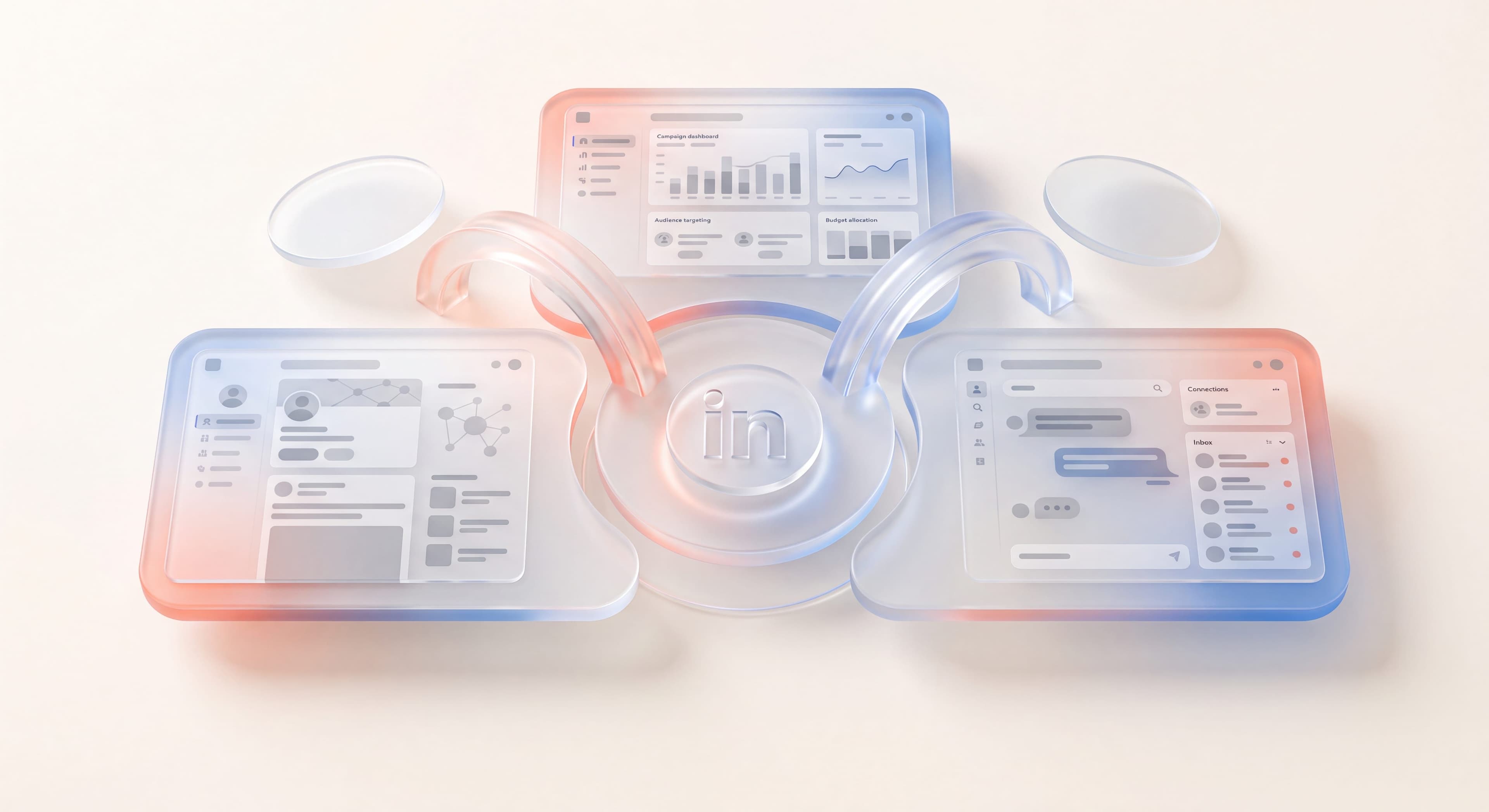
At Moriah, we run LinkedIn as one engine built on three pillars that always operate in parallel, all aimed at a single business objective at a time. This is the heart of how we work, and it's how LinkedIn actually performs. Sure, a page can zero in on any one pillar, but the pillars only produce outcomes when they run together. That's the whole idea.
Pillar 1: Executive Personal Branding
Personal branding means positioning your leaders, and your company, as credible voices in your industry through consistent LinkedIn content. This is the foundation, because it's what makes everything else believable. When a prospect gets a message or sees an ad, the first thing they do is check the person behind it. If that profile is publishing substantive, relevant thinking, the conversation starts warm.
A cadence that works is 1 - 3 posts per week from the relevant executive's personal page, not the company page, for the reason above. The aim isn't viral reach. It's steady, on-brand authority that backs up whatever you're actually chasing: thought leadership, market presence, partnerships, or visibility to investors and institutions.
Pillar 2: Targeted Outreach
Targeted outreach is direct, qualified LinkedIn messaging aimed at the specific decision-makers who match your ideal customer. This is where content turns into conversations. Done well, it's precise and low-volume in the way that counts. Every message goes to someone who fits, sent from a profile that already looks credible.
Outreach works so much better than cold email on LinkedIn because the two channels aren't the same animal. On LinkedIn, the recipient can see exactly who you are, what you publish, and who you know in common. That context is why reply rates tend to sit around 10 - 15% when the targeting and the profile are both right.
Pillar 3: LinkedIn Ads
LinkedIn Ads are paid amplification, brought in when it serves the objective rather than by default. Ads let you put your best-performing content and offers in front of the precise accounts and roles you care about, stretching the reach of the branding and outreach work. Used surgically, they compress the timeline. Used as a standalone play, they rarely earn back the spend.
The point of the three-pillar model is that these aren't three separate campaigns. They're one coordinated motion. Content gives outreach something to stand on, outreach turns attention into pipeline, and ads amplify what's already working, all pointed at the same business objective.
Start With the Objective, Not the Tactic
The right way to build a LinkedIn sales motion is to start from the business objective and work backward to the plays. Just about any objective has an answer once the LinkedIn strategy is right. Before you decide what to post or who to message, get specific about what you're actually trying to achieve:
- Generate qualified leads: lead with targeted outreach, supported by content that gives prospects a reason to engage.
- Become a thought leader in your industry: lead with personal branding, amplified by ads to reach beyond your existing network.
- Create new partnerships: combine authority-building content with direct outreach to the right counterparts.
- Open or consolidate a new market: coordinate all three pillars to establish presence where you have none.
- Be visible to private equity, VC firms, and institutions: publish the kind of content those audiences respect, then put it in front of them.
- Recruit: use the same engine to attract talent that already follows your industry on LinkedIn.
Once the objective is clear, the mix of the three pillars falls out of it. When a client's buyers aren't posting much themselves, we lean harder on targeted outreach. When the objective is pure awareness, personal branding content can carry more of the weight. The engine adapts. The principle doesn't.
What a Real LinkedIn Sales Motion Looks Like
Here's how the pieces fit together in practice, starting from scratch:
- Define the objective and the ideal customer. Everything downstream hinges on knowing exactly who you're trying to reach and why.
- Confirm your audience is genuinely active on LinkedIn. Not every category is. We check this before doing anything else, because if your buyers aren't on the platform, no amount of effort will manufacture pipeline.
- Build executive authority through content. Stand up the personal profiles that outreach and ads will lean on, publishing 1 - 3 times per week.
- Run targeted outreach to qualified prospects. Direct, relevant messaging to the right decision-makers, sent from profiles that now have some substance behind them.
- Amplify with ads where it's warranted. Put proven content and offers in front of the exact accounts you want.
- Measure against pipeline, not vanity metrics. Impressions and follower counts are inputs. Conversations, qualified opportunities, and closed business are the outputs that actually matter.
This is deliberate, structured work, and it's also why so many companies struggle to pull it off in-house. It takes strategy, consistent content production, disciplined outreach, and ad management all running at once, aimed at the same business objective. Any one of those is a job on its own. All four together, coordinated, is a function.
How Moriah Runs LinkedIn as One Engine
Moriah is a done-for-you LinkedIn marketing agency. We run personal branding, targeted outreach, and LinkedIn Ads together, in-house, as a single engine pointed at your business objective. We handle strategy, content production, and execution. The client brings the objective, subject-matter input, and a willingness to publish from the relevant executive's personal page.
A few things worth knowing about how we work:
- We run all three pillars together, always. Most agencies do just one, whether that's ghostwriting, ads, or outreach. For any objective beyond pure awareness, you need the combination, because that's simply how LinkedIn performs. This 360° approach is our core difference.
- We work across roughly a dozen industries including business services, manufacturing, transport, logistics, and other established sectors, with relevant benchmarks for each.
- We prove value through real business cases. We work with companies like ESME, Adviso Partners, Foghorn Therapeutics, Vinci Technologies, and AWI, and we bring exact, verifiable results to the table instead of promises.
- There's no commitment. No minimum term, no lock-in, cancel anytime. The model is launch, measure, prove. It takes enough time to gather real data and show results, but you're never tied in.
- In the US, the engagement is a flat $4,000/month retainer covering all three pillars, run in-house. It's a premium, full-service engagement built for established B2B companies, not a per-post or per-tool subscription.
If you've decided LinkedIn "doesn't work" for your business, there's a good chance you only ever saw one pillar running on its own. The channel is where your buyers are. The real question is whether you run it as a genuine business engine or as a static communication page.
Frequently Asked Questions
What is LinkedIn for B2B sales? LinkedIn for B2B sales is the practice of using the platform to build pipeline with decision-makers, through executive content, direct outreach, and paid amplification. It works because your buyers already keep a professional identity there, which makes it the natural place for business conversations to start.
Why is LinkedIn better than cold email for B2B sales? On LinkedIn, the recipient can see who you are, what you publish, and who you know in common, and that makes outreach far warmer than an unsolicited email. In practice, well-targeted LinkedIn outreach earns roughly 10 - 15% reply rates, versus about 1 - 3% for cold email.
Should I post from my personal profile or my company page? Post from your personal profile. Content from a personal profile performs roughly 5 - 10× better than the same content from a company page, because buyers trust people over logos. Company pages still have a role, but the sales-driving content should come from your leaders.
How often should I post on LinkedIn for B2B sales? A cadence of 1 - 3 posts per week from the relevant executive is enough to build steady authority without burning anyone out. Consistency beats volume here. Regular, substantive posts outperform the occasional flurry.
Can LinkedIn Ads generate B2B sales on their own? Rarely. Ads work best as amplification for content and outreach that are already performing, letting you reach precise accounts and roles. On their own, without credible profiles or a follow-up motion behind them, they seldom earn back the spend.
What is social selling on LinkedIn? Social selling is building relationships with prospects through content and genuine engagement before you make a direct ask, rather than opening with a pitch. On LinkedIn, that means establishing credibility through your profile and posts so outreach lands warm.
How do I measure LinkedIn sales success? Measure against pipeline, not vanity metrics. Track qualified conversations, opportunities created, and closed business. Impressions, likes, and follower counts are inputs, not outcomes.
Does LinkedIn for B2B sales work for every company? No. It works when your target buyers are genuinely active on LinkedIn, and that isn't true of every category. Established B2B companies in sectors like business services, manufacturing, transport, and logistics are usually a strong fit. We check audience activity before engaging.
Why do so many companies fail at B2B sales on LinkedIn? Because they run one tactic in isolation, either content with no outreach, or outreach with no content behind it. LinkedIn sales is a system where personal branding, outreach, and ads make each other work. Skip a pillar and the results collapse.
How much does it cost to run LinkedIn for B2B sales professionally? Moriah's US engagement is a flat $4,000/month retainer covering all three pillars, personal branding, targeted outreach, and LinkedIn Ads, run in-house with no minimum commitment. The pricing reflects a full-service engagement built for established B2B companies rather than a per-post or tool-based cost.
---
Ready to turn LinkedIn into a real sales engine for your company? Book a call and we'll walk through what a coordinated LinkedIn motion would look like for your objective.