B2B Lead Generation Funnel: How to Measure It and Find the Leaks
A measurement-first guide to the B2B lead generation funnel: how to define each stage by an observable action, what conversion rate to expect between stages, and how to read a leak from the numbers.

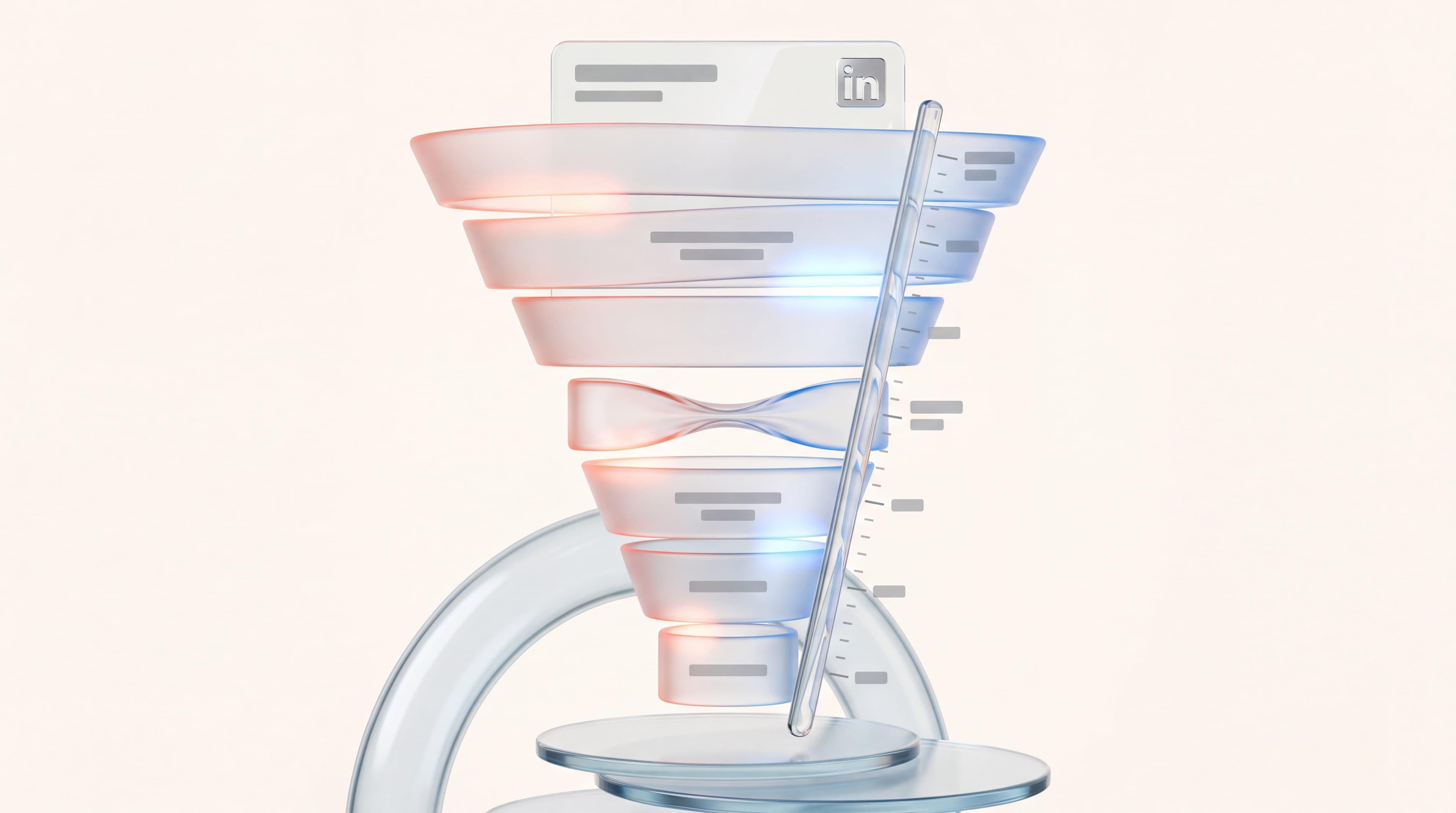
A funnel diagram almost never tells you the truth about a business. I've been handed plenty of them. Four tidy bands, wide at the top, narrow at the bottom, arrows pointing down, and underneath the slide a company whose new business has been flat for three quarters. The diagram wasn't wrong, exactly. It just wasn't measuring anything.
I'm Léo Le Henaff, Co-founder & CTO at Moriah, a LinkedIn Certified Marketing Partner. My background is software and data engineering, and I own the systems that run our LinkedIn workflows for established B2B companies. Which means most of my week goes on the numbers rather than the slides.
So, the position this article takes. A B2B lead generation funnel is not a picture of how buyers feel on their way to a purchase. It's a measurement model, and its only job is to tell you where buyers stop moving and roughly what that costs you. What follows: how to define every stage by something observable, the conversion rate a B2B team should expect between each pair of stages, how to read a leak out of the figures, and the one handoff where B2B funnels actually break.
What a B2B lead generation funnel actually is
Treat the funnel as an instrument rather than an illustration. An instrument has to satisfy three conditions, and most of the funnels I get shown fail at least one.
Every stage has an entry test that two different people would apply the same way. If your sales director and your marketing manager would sort the same record differently, that stage is decorative.
Records enter a stage only when the test is met. Not when someone feels optimistic, and not because a quarter is ending.
You can count two different things: the population sitting in each stage right now, and the flow between stages over a period. Those answer different questions, and they get conflated constantly. A fat stage with healthy flow is a long sales cycle. A fat stage with no flow is a blockage. On a diagram the two look identical.
Notice what's missing from that list: realism about the buyer. Real B2B buyers loop, stall, vanish for a quarter, come back with a new job title, and pull in people you never spoke to. The funnel doesn't have to be faithful to any of that. It has to be countable. Those are separate goals, and trying to make one model serve both is how companies end up with five stages named after emotions.
Define every stage by an observable action
Here's the definitional spine I'd hold any B2B lead gen funnel to. The stage names matter far less than the middle column.
| Stage | What puts a record here | What does not count |
|---|---|---|
| Reached | A named person at a target account was exposed to something you controlled: an ad served, a message delivered, a post shown in their feed | Being added to a list, or appearing in a data provider |
| Engaged | That person did something that took effort: replied, filled in a form, commented substantively, accepted a connection and then wrote back | A like, a profile view, an impression |
| Inquiry | They asked you for something specific: a meeting, a price, a document, an introduction | Seeming interested, or opening an email three times |
| Marketing-qualified | An inquiry that also passes a written fit test against your target profile, applied by rule | A number from a scoring model nobody can explain |
| Sales-accepted | A named salesperson has read the record and agreed to work it, inside an agreed window | The record appearing in somebody's queue |
| Opportunity | A meeting took place and both sides agreed a next step with a date on it | A meeting was booked, or a meeting happened |
| Closed won or lost | A signature, or a recorded reason there will not be one | Going quiet |
Two rules come out of that table.
If a stage definition contains a feeling, you cannot measure it. Awareness, interest, consideration and intent are useful words in a strategy conversation and dead weight in a funnel. Translate each one into an action a system can see, or delete the stage.
Records must be allowed to move backwards, and the move has to be recorded with a reason. Most CRMs let stages ratchet forward only, so a record that quietly stops progressing just sits there and ages. That isn't a neutral default. It's probably the most common reason a funnel can't show you its own biggest problem.
The conversion rate to expect between each pair of stages
Published B2B funnel benchmarks disagree with each other badly. Depending on which source you happen to pick up, marketing-qualified to sales-qualified lands anywhere from about 13% to about 40%. That spread isn't sloppy research. It's what happens when every company defines its stages differently, so the figures were never measuring the same transition to begin with.
Use the ranges below the way you would use a reference weight: to notice that something is obviously off, not to set a target.
| Step | Working range | How to read it |
|---|---|---|
| Reached to Engaged | 2% to 12% | The widest range in the funnel, because the channel does most of the work here |
| Engaged to Inquiry | 15% to 30% | Below this, your engaged definition is probably counting likes |
| Inquiry to Marketing-qualified | 50% to 75% | Much higher means the fit test is too loose. Much lower means you are reaching the wrong accounts |
| Marketing-qualified to Sales-accepted | 60% to 80% with an agreed handoff, 30% to 50% without one | The step with the most movement available in it |
| Sales-accepted to Opportunity | 60% to 80% | A real meeting with a real next step |
| Opportunity to Closed won | 20% to 30% | Stable over time in most established B2B businesses |
The top of that table is where channel choice stops being an opinion and becomes arithmetic. Targeted LinkedIn outreach typically gets reply rates in the 10% to 15% band, against roughly 1% to 3% for cold email. Content published from an executive's personal profile performs around 5 to 10 times better than the same content from a company page. Those aren't small refinements. They set the scale of everything downstream.
Three warnings about using benchmark ranges at all.
Your own trailing four quarters is the only benchmark that counts. Work out the six step ratios every quarter and keep the series. A ratio that's fallen by a third against your own median is a finding. A ratio sitting ten points off somebody's published average is a coincidence.
Don't multiply the ranges end to end and then plan on the result. Six ranges compounded gives you a final number somewhere between negligible and implausible, which is a fancy way of knowing nothing.
Watch the denominator. Dividing this quarter's closed deals by this quarter's new leads isn't a conversion rate when your sales cycle runs five months. Follow a cohort instead: take everything that entered the funnel in one period and track that same set forward.
How to read a leak from the numbers
Diagnosis is a four step routine, and the order matters.
1. Cohort the entries. Pick a period, take everything that entered the first stage inside it, and follow that population through. What you want is one set of records watched over time, not six unrelated period totals stacked on top of each other.
2. Work each step ratio out against your own history. Six numbers, measured against your own median, with the benchmark table as a sanity check and nothing more.
3. Rank the gaps by deals lost, not by percentage points. This is where most diagnoses go wrong. To value a shortfall, multiply it through every rate sitting below it. A ten point miss at the top of the funnel, carried through a 25% closing rate, is worth far less than a twenty point miss one step above the close. The ugliest looking ratio often isn't the expensive one.
4. Separate rate from time. A stage can convert at a perfectly normal rate and still be your worst problem, if it takes six days where it used to take one. Put median days in stage next to every ratio. Rate tells you whether records get through. Time tells you whether they get through while the buyer still cares.
Two distinctions worth holding onto while you do this.
A dam is a volume problem: the rates are fine, there just isn't enough coming in. A leak is a rate problem: plenty enters and it doesn't come out. The two call for opposite responses, and buying more reach to fix a leak is the most expensive mistake in B2B lead generation.
Then the leak that shows up nowhere at all: the unlabeled exit. If 37 records left a stage and only 9 carry a recorded reason, you don't have a funnel with a small gap in it. You have a blind spot. In my experience that's where the money is.
The handoff where B2B funnels actually fail
In almost every established B2B funnel I've looked at, the weakest transition is marketing-qualified to sales-accepted.
The reason is structural. It's the only step in the whole model where ownership changes hands. Every other transition runs on the buyer doing something, or on one team doing its own work. This one needs a person in a different function, carrying different targets, to pick a record up. That's exactly why the sales-accepted lead stage exists in the demand waterfall model popularized by SiriusDecisions, now part of Forrester: the moment was going unmeasured. Study after study since has put the share of marketing-sourced leads that sales never works at somewhere uncomfortably high, and those numbers disagree with each other about as much as the stage definitions do. I won't pretend the exact proportion holds in every company. I will say I've never audited a funnel where this was the strongest step.
Why clean stage definitions still leak
This is the part that catches out people who have just finished a careful definitions exercise. You can write a faultless marketing-qualified rule, get both teams to sign it, and still lose most of the records at the handoff. The reason is simple enough: a definition describes a record, and a handoff governs a person.
A stage definition has no answer to any of four questions:
- Who, by name, owns this record from the moment it qualifies?
- Within how many working hours must they look at it?
- What are the permitted outcomes of looking at it?
- What happens if they do none of them?
Where those answers are missing, acceptance stops being a decision anybody makes. It becomes something that happens to the records a salesperson happened to open. The dominant failure mode is the silent reject: no action, no reason, no record. The lead never gets rejected, it just never gets accepted either, so it sits in the previous stage and ages quietly while both teams report their own numbers accurately and disagree about reality.
What an agreed handoff looks like
- A named owner per record, assigned by rule. Round robin, territory, account owner, whatever fits your setup. Assignment by meeting doesn't scale and never gets measured.
- A response window, in working hours, written down. One or two business days is a defensible commitment for an established B2B company. What matters is less the number itself than the fact that a number exists.
- Three permitted outcomes and only three: accept, reject with a reason from a fixed list, or return for more information. The fixed list is load bearing, since free-text reasons can't be counted.
- A standing rule for no response. The record returns automatically and the non-response is logged against the owner. That's the thing that turns a silent reject into data.
- A weekly joint read of the rejection reasons. Those reasons are the most valuable output of the whole funnel, because they tell the marketing side what to stop producing. A handoff process that generates reasons nobody reads is half built.
One more thing moves the acceptance rate without any process change at all: whether the salesperson recognizes the company and the person. A record from an account whose decision maker has been reading your executive's posts for two months gets opened and worked. A record from a bought list doesn't, and no service level agreement will make anyone enthusiastic about it. This is measurable, by the way. Split your acceptance rate by whether the contact had prior observable engagement with your executives' content. The two numbers are rarely close.
A worked diagnosis
Here's a plausible quarter for an established B2B company. The figures are illustrative, built to show the method rather than lifted from one client.
| Stage | Records | Step rate | Median days in stage |
|---|---|---|---|
| Reached | 4,000 | ||
| Engaged | 420 | 10.5% | 3 |
| Inquiry | 96 | 22.9% | 4 |
| Marketing-qualified | 68 | 70.8% | 1 |
| Sales-accepted | 31 | 45.6% | 6 |
| Opportunity | 24 | 77.4% | 11 |
| Closed won | 6 | 25.0% | 38 |
Read the step rate column against the ranges above. Engaged to inquiry at 22.9% looks like the harshest drop on the chart, and it sits comfortably inside normal. Inquiry to qualified, sales-accepted to opportunity, opportunity to won: all unremarkable. Exactly one number falls outside its band. Marketing-qualified to sales-accepted at 45.6%, against the 60% to 80% you'd expect where a handoff agreement exists.
Now put a value on the two candidate fixes, carrying each one through the rates below it.
Fix the handoff. Lift acceptance from 45.6% to 70% and you accept 48 records instead of 31, a gain of 17. Carry those through at 77.4% and 25% and you land about 3.3 extra closed deals in the quarter.
Fix the top instead. Say a reach and messaging push lifts engaged to inquiry from 22.9% to 27%, which is genuine work. That's 17 more inquiries, about 12 more qualified records, and at the current 45.6% acceptance rate roughly 5.5 more accepted. Carried down, about 1.1 extra deals.
Same effort on paper, triple the result, and the handoff fix costs nothing except agreement. That's the general shape of it. A leak below a stage throws away the work of every stage above it, so fixing a low leak is almost always worth more than widening a high one.
The time column confirms the diagnosis independently. Records sit six days waiting to be accepted, six times as long as the qualification step right before it. And here's the detail that settles the argument: of the 37 qualified records never accepted, only 9 carry a rejection reason. The other 28 were never rejected at all. Nobody declined them. They just weren't picked up, which is the silent reject the funnel was never built to show.
So the quarter's finding isn't a lead generation problem. It's one unowned transition, costing around three deals a quarter, invisible on every chart either team presents.
When one engine feeds the funnel
An honest point before I land this on our own model. Everything above is channel-agnostic. It works whether the top of your funnel is search, email, conferences, partners, a referral network, or a stand at an industry show. Nothing in it belongs to one route to market. If you run several, run these numbers per route as well as in aggregate, because blending them hides the exact differences you were looking for.
Moriah's own answer is deliberately narrower. We're a LinkedIn marketing agency and we run three pillars: executive personal branding, targeted outreach, and LinkedIn Ads, all executed in house against one business objective at a time. We don't run your search, your email program, your events or your PR, and I wouldn't claim a funnel can only be filled from LinkedIn. What I will claim is what a single channel, run properly, buys you in measurement terms.
One denominator. Most attribution arguments inside B2B companies are really arguments about which channel to credit. With one engine feeding the top, that argument mostly goes away and the attention can go on the transitions instead.
Observable stages rather than inferred ones. Every stage in the table near the top of this article is directly visible on LinkedIn: the impression served, the message delivered, the reply written, the comment left, the connection accepted. You're counting events, not modeling them.
Three pillars sitting on different steps of the same funnel. This is why they only work together, and it's a measurement statement rather than a sales one. Personal branding does its work on reached to engaged and, quietly, on the acceptance rate, since the salesperson is now opening a record the buyer already recognizes. Targeted outreach is what turns engaged into an inquiry. LinkedIn Ads widen the reached stage when the objective justifies it. The failure patterns follow from that. A company that publishes consistently but activates nothing around it gets no business. A company that sends outreach with no content standing behind it gets no business either. One pillar feeds a step whose neighbors are empty.
That's the whole argument for running the three as one engine instead of buying them separately. A funnel is a chain of ratios, and the output is set by the weakest link, never the strongest.
If you want a second read on where your own numbers are leaking, that's the conversation we have on a first call. Our engagement is a monthly retainer with no commitment and no minimum term, and it's built that way for this exact reason: the early work is about gathering real data points on your funnel, not about locking you in.
Frequently Asked Questions
What is a B2B lead generation funnel? A B2B lead generation funnel is a measurement model that tracks how many potential buyers move from first contact to a closed deal, and where they stop moving. Each stage gets defined by an observable action, which lets you count both the records sitting in a stage and the flow between stages.
What are the stages of a B2B lead generation funnel? A workable set is reached, engaged, inquiry, marketing-qualified, sales-accepted, opportunity, and closed won or lost. The names are negotiable. What isn't: every stage needs an entry test that two different people would apply identically.
What is a good conversion rate for a B2B lead generation funnel? Useful working ranges are 2% to 12% from reached to engaged, 15% to 30% from engaged to inquiry, 50% to 75% to marketing-qualified, 60% to 80% to sales-accepted, 60% to 80% to opportunity, and 20% to 30% to closed won. Published benchmarks vary widely because companies define their stages differently, so your own trailing four quarters is the more reliable comparison.
How is a lead generation funnel different from a sales pipeline? The funnel measures the whole flow from first exposure onward, and it's mostly about rates between stages. A pipeline is the set of live deals a sales team is working, valued and dated, and it's mostly about forecasting. The funnel tells you why the pipeline is the size it is.
What is the difference between an MQL and a sales-accepted lead? A marketing-qualified lead has passed a fit and interest test applied by marketing. A sales-accepted lead is one a named salesperson has read and agreed to work inside an agreed window. The gap between those two counts is usually the biggest single loss in a B2B funnel.
Where do most B2B funnels leak? At the handoff from marketing-qualified to sales-accepted, because it's the only transition where ownership changes function. Records are rarely rejected there on purpose. They just never get picked up, and nothing in the funnel records that.
Why does my funnel still leak when every stage is clearly defined? Because a stage definition describes a record while a handoff governs a person. Until you've named an owner, a response window, a fixed list of permitted outcomes, and a rule for what happens when none of them occur, acceptance isn't a decision anyone is actually making.
How do I tell a volume problem from a conversion problem? Compare your step rates with your own history. If the rates look normal and the first stage is thin, you have a volume problem and need more reach. If plenty enters and the rates have dropped, adding reach only pushes more records into the same leak.
How many stages should a B2B lead gen funnel have? As few as you can measure reliably, usually five to seven. Every extra stage adds a transition you have to define, own and report, and a stage nobody can test consistently makes the whole model less trustworthy rather than more detailed.
Can one channel fill an entire B2B lead generation funnel? It can, assuming your buyers are genuinely active there and you run more than one play on it. Moriah's position is that LinkedIn qualifies for established B2B companies when executive personal branding, targeted outreach and LinkedIn Ads run together, because each one carries a different step of the funnel.