Using LinkedIn for B2B Marketing: The Complete 2026 Playbook
How established B2B companies use LinkedIn as a real business engine, combining personal branding, targeted outreach, and LinkedIn Ads to drive measurable outcomes.

Most B2B leaders I talk to already know they "should be doing something on LinkedIn." The part they're fuzzy on is what that something actually is. There's a company page that posts every few weeks. Maybe a sales rep fires off the occasional connection request. And the results match the effort, which is to say: not much.
I'm Raphael Presberg, Founder and CEO of Moriah, a LinkedIn Certified Marketing Partner. We help established B2B companies turn LinkedIn into a measurable business engine. Not a place where you post and hope, but a system that produces leads, partnerships, and actual market presence. This guide lays out how using LinkedIn for B2B marketing works in practice once you stop treating it like a notice board and start treating it like a business engine.
Why LinkedIn Is the Default Channel for B2B Marketing
LinkedIn is where your buyers already are. It's the one platform built specifically around professional decision-making, which is part of why roughly 80% of B2B leads sourced from social media come from LinkedIn. For B2B marketing, no other channel packs that many decision-makers into one place with their job title, company, and seniority sitting right there on the profile.
Here's the gap I run into constantly. Most companies still treat LinkedIn the way they did a decade ago, as a recruitment site or a static place to push announcements. They picture a company page where you post news. That was a fair picture before, but it's not the whole story anymore. These days a meaningful share of B2B buying conversations start on LinkedIn, and the companies winning on it are the ones that stopped broadcasting and started building an actual presence.
The shift matters because the platform now rewards it. The 2026 algorithm leans toward authentic engagement and real conversations rather than corporate broadcasting. Content from a personal profile tends to outperform the same content from a company page, and in our experience the gap is something like 5 - 10×. So if your whole LinkedIn strategy runs through a logo, you're betting everything on the one format the platform reaches least.
The Mistake That Kills Most B2B LinkedIn Strategies
The single biggest mistake in B2B marketing on LinkedIn is doing one thing in isolation.
Some companies only publish content. They post thoughtful articles, build a small audience, and then... nothing happens, because nobody is actually reaching out to the people reading. Others only run outreach. They fire off hundreds of connection requests with no content behind them, so when a prospect clicks through to the profile, there's nothing there to build any trust. And a few only run ads, paying to reach people who have no earthly reason to recognize the brand.
Each of these can look like "doing LinkedIn marketing." On its own, none of them produces consistent business outcomes.
The reason is pretty simple. A buyer's path on LinkedIn isn't a straight line. Someone sees a post, scrolls past it, gets a message a week later, half-recognizes the name, clicks the profile, reads more, then catches an ad, and finally books a call. Pull any one of those touchpoints out and the chain snaps. Content with nothing to activate it goes nowhere. Outreach with no content behind it gets ignored. That's exactly why, at Moriah, we run all three together as one engine instead of as separate campaigns.
The Three Pillars of Using LinkedIn for B2B Marketing
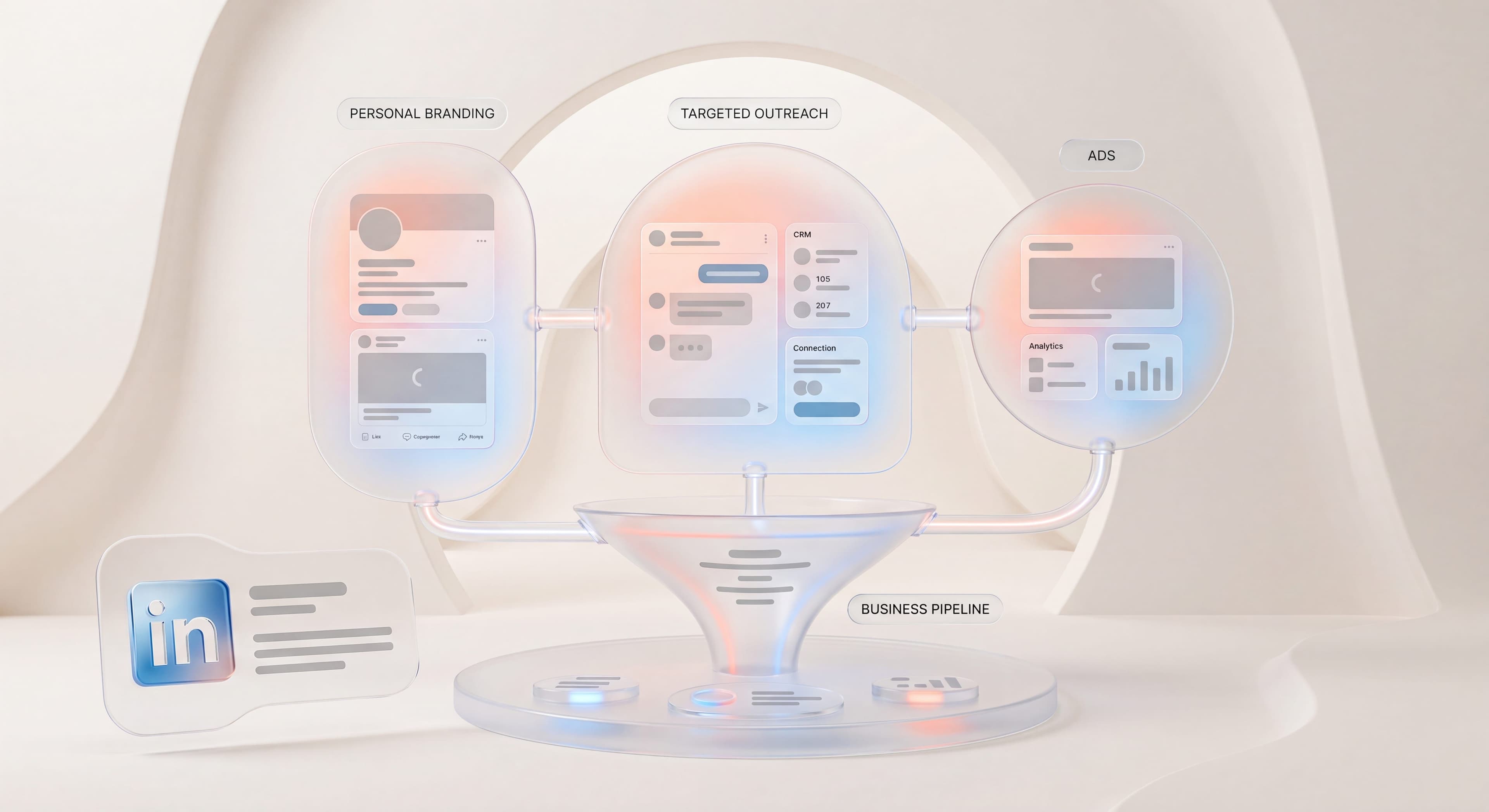
Using LinkedIn for B2B marketing well means running three pillars in parallel, all aimed at the same business objective. Here's what each one does, and why it only really works next to the others.
Pillar 1: Personal Branding
Personal branding means positioning your company's leaders, and the company itself, as credible voices in your industry through consistent LinkedIn content. This is the foundation. It's what makes everything else believable.
When a prospect gets your message or spots your ad, the first thing they do is check the profile. If that profile is publishing sharp, genuinely useful content a few times a week, your outreach reads as a conversation with someone worth talking to. If it's empty, your outreach reads as spam.
A few principles we stick to:
- Publish from a personal profile, not just the company page. Personal posts carry far more organic reach, and people simply trust people more than they trust logos.
- Post consistently, somewhere around 1 to 3 times a week. Consistency beats any single viral post. The algorithm rewards a steady presence over a lucky one.
- Lead with point of view, not product. What you're after is authority on the topics your buyers care about, not a feed of announcements.
Pillar 2: Targeted Outreach
Targeted outreach is direct, qualified LinkedIn messaging aimed at the specific decision-makers you want as customers. This is the pillar that turns an audience into pipeline.
What LinkedIn outreach has over cold email is engagement. Cold email tends to land somewhere in the 1 - 3% reply range, while well-targeted LinkedIn outreach sits closer to 10 - 15%. The difference is context. On LinkedIn the person can see exactly who you are, and if your branding pillar is doing its job, they already have a reason to write back.
The word that earns its keep here is targeted. This isn't mass-blasting connection requests. It's picking the right people at the right companies and reaching out with something relevant to say. Done well, outreach is where conversations with real decision-makers actually start, and it scales. A focused program can run on the order of 200 qualified messages a week without ever feeling automated to the person on the other end.
Pillar 3: LinkedIn Ads
LinkedIn Ads are paid amplification, used when they serve the objective rather than switched on by default. Ads aren't the engine. They're the accelerator. They stretch the reach of your best content and put your message in front of qualified audiences who haven't connected with you yet.
LinkedIn's targeting is what makes its ads worth the premium price. You can reach people by job title, seniority, company, and industry with a precision no other ad platform really matches for B2B. But ads work best when there's something behind them: a credible profile, real content, conversations already happening. Run alone, they're just expensive. Run on top of the other two pillars, they compound everything.
How the Three Pillars Work Together
The combination is the whole point. Here's what it looks like in practice:
- Personal branding builds an audience and establishes credibility. Prospects start recognizing your leaders' names and their points of view.
- Targeted outreach activates that audience. Now when you message someone, they've probably already seen your content, so the conversation starts warm instead of cold.
- LinkedIn Ads amplify the strongest content and keep your brand in front of the accounts that matter, reinforcing the other two pillars.
Each pillar makes the other two more effective. Content makes outreach land. Outreach turns readers into conversations. Ads scale the reach of both. That's why we don't sell these as separate services you can pick off a menu. Running personal branding, targeted outreach, and ads as one coordinated engine is the entire concept, because it's how LinkedIn actually performs.
Start From the Objective, Not the Tactic
The best way to plan your LinkedIn marketing strategy for B2B is to start from the business objective and work backward to the plays. Almost any goal an established company has can be pursued on LinkedIn:
- Generate qualified leads → outreach-led, with content building trust and ads expanding reach.
- Become a thought leader in your industry → branding-led, with consistent executive content.
- Create new partnerships → branding plus targeted outreach to the right counterparts.
- Enter or consolidate a new market → all three pillars focused on a single geography or segment.
- Launch a new offer or service → content to frame it, outreach to start conversations, ads to amplify.
- Be visible to private equity firms, VCs, and institutions → executive branding that puts your leadership on their radar.
The mix shifts with the goal. If your buyers aren't yet active content creators themselves, you lean harder on outreach. If pure awareness is the point, branding posts alone can carry a lot of it. But the principle holds: name the objective first, then build the engine around it.
Measuring What Actually Matters
The right metric for B2B marketing on LinkedIn is pipeline, not vanity. Likes and impressions feel good, but they don't pay the bills. Tie your measurement to business outcomes:
- Conversations started with qualified decision-makers
- Meetings booked off the back of LinkedIn activity
- Opportunities and pipeline attributed to the channel
- Profile and content engagement from your actual target accounts, not just total reach
If a metric doesn't connect back to revenue or a concrete objective, it's a vanity number. We measure the engine against the objective it was built to serve, gather real data, and adjust the mix from there.
Why Companies Hand This to a Specialist
Running all three pillars in parallel, week after week, is more than most internal teams can keep up. Content a few times a week, 200 qualified outreach messages, ad management, and the coordination to keep all of it pointed the same way. That's a full operation, not a side task for one already-stretched marketer.
At Moriah, we run the whole engine in-house for established B2B companies: strategy, content, outreach, and ads, all coordinated toward one objective. We're a LinkedIn Certified Marketing Partner, and we work on a no-commitment basis, no lock-in and cancel anytime, because we'd rather prove the results than tie you down. We don't sell training or courses. We do the work for you.
If you want more customers, partnerships, or market presence out of LinkedIn, the path is the same: build the engine, run all three pillars together, and measure against real outcomes.
Frequently Asked Questions
What does using LinkedIn for B2B marketing actually involve? Using LinkedIn for B2B marketing means combining personal branding (consistent executive content), targeted outreach (direct messaging to qualified decision-makers), and LinkedIn Ads into one coordinated system. Run together, these tend to produce leads, partnerships, and market presence, far more than any single tactic manages on its own.
Why is LinkedIn better than other platforms for B2B marketing? LinkedIn gathers professional decision-makers in one place with their job title, company, and seniority attached, which is a big reason roughly 80% of B2B social media leads come from it. No other platform really matches that combination of audience and targeting precision for B2B.
Should I post from my personal profile or my company page? Both, but lean toward personal profiles. Content from a personal profile typically reaches 5 - 10× more people than the same content from a company page, because the algorithm and the people on it both favor people over logos. Company pages still have a job to do for official presence, they just shouldn't carry your whole strategy.
How often should I post on LinkedIn for B2B marketing? Aim for 1 to 3 posts a week from your key people, published consistently. Consistency matters more than volume or any single viral post. A steady cadence keeps you visible in the algorithm and builds recognition over time.
Is LinkedIn outreach more effective than cold email? Usually, yes. Cold email tends to get around 1 - 3% replies, while well-targeted LinkedIn outreach lands closer to 10 - 15%. The difference is context. On LinkedIn prospects can see who you are, and if you're publishing good content, they already have a reason to respond.
Do I need to run LinkedIn Ads to succeed? Not always. Ads are an accelerator, not the engine. They work best layered on top of strong content and active outreach, amplifying what's already working. For pure awareness or pushing your top content further they're valuable, but they shouldn't run in isolation.
Can't I just do one of these, like only content or only outreach? You can, but it rarely produces consistent business outcomes. Content with nothing to activate it goes nowhere, and outreach with no content behind it gets ignored. The pillars deliver real results when they run together, because a buyer's path on LinkedIn moves across all of them.
How do I measure whether LinkedIn marketing is working? Measure pipeline, not vanity metrics. Track conversations started with qualified decision-makers, meetings booked, opportunities created, and engagement from your actual target accounts. If a metric doesn't connect back to revenue or a specific objective, it's a vanity number.
How much does professional LinkedIn marketing cost? A full-service, done-for-you engagement that runs all three pillars in-house is a premium monthly retainer. Moriah's pricing is $4,000/month in the US, £3,000/month in the UK, and €3,000/month in France. There's no per-post or per-tool pricing; you're paying for the complete engine, executed for you.
How long before LinkedIn B2B marketing produces results? It takes enough time to gather real data and show results, but you're never locked in. At Moriah we work with no commitment, no minimum term and cancel anytime, and we run the engine long enough to prove the outcomes against your objective before you decide whether to continue.