LinkedIn Dynamic Ads: When Being Named Earns Attention
LinkedIn dynamic ads auto-insert each viewer's own profile details. A plain explanation of the mechanic, then the judgement that decides it: whether the reader already recognizes your company.

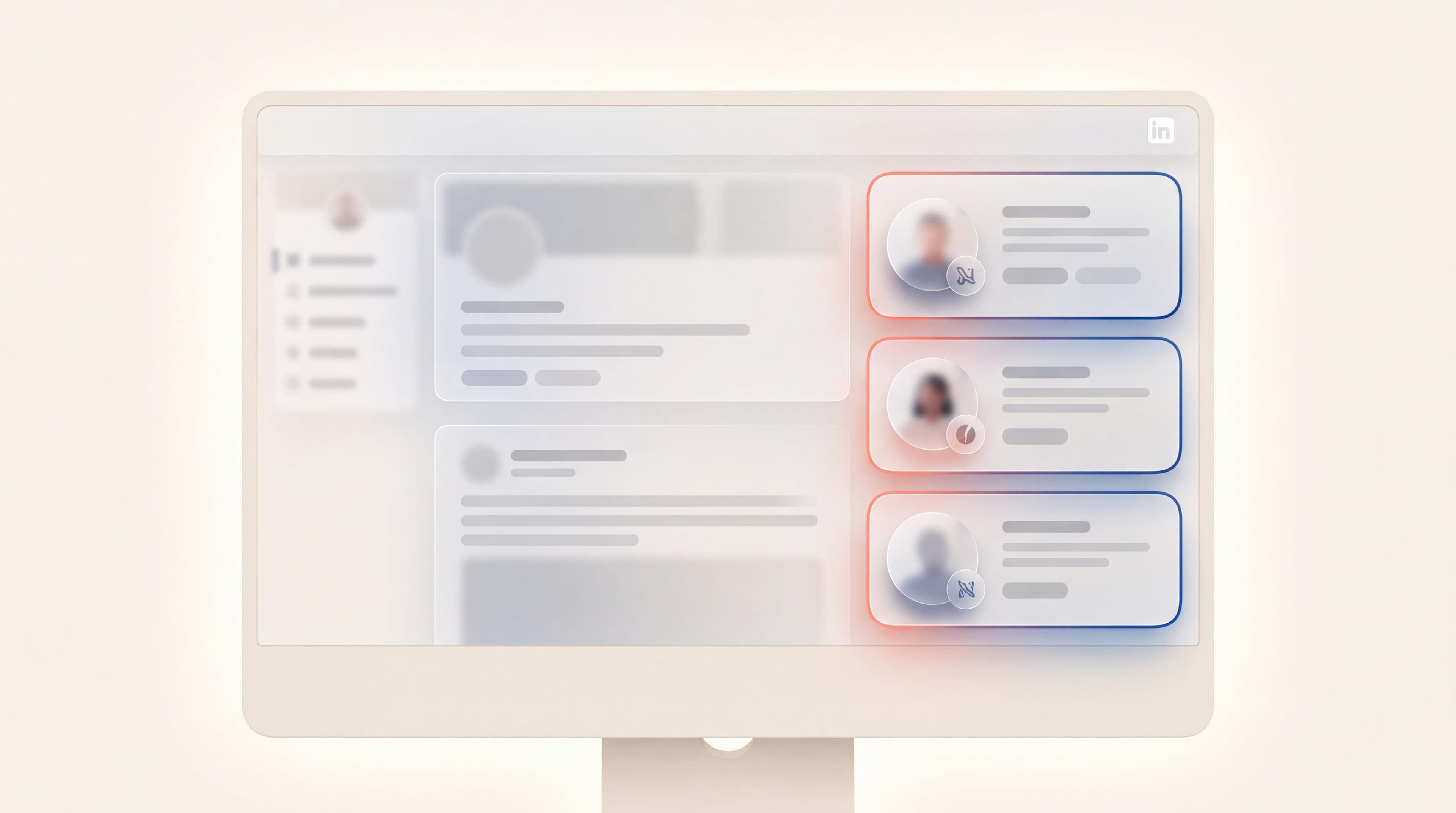
Two people get shown the same LinkedIn dynamic ad on the same Tuesday afternoon. Each unit carries that person's own photograph, their own company name, and an identical line of copy underneath.
The first reader has had your chief executive's posts in her feed for three months. To her, the ad reads as a company she already half-follows acknowledging that she exists.
The second reader has never heard of you. To him, the same ad reads as a stranger with his file open.
Nothing in the creative explains the gap. Same copy, same targeting criteria, same money per impression. What separates the two outcomes sits entirely outside the campaign, and it is the factor almost nobody checks before switching the format on.
I am Léo Le Henaff, Co-founder and CTO of Moriah, a LinkedIn Certified Marketing Partner working with established B2B companies. I own the systems that run our clients' LinkedIn work, so I spend a lot of my week on what a platform will and will not assemble on your behalf. LinkedIn dynamic ads are the clearest case I know of a format where the mechanic is easy and the judgement is hard. Both are below, in that order.
What LinkedIn Dynamic Ads Actually Do
Dynamic ads are a family of LinkedIn ad units built at the moment someone looks at them. You supply the fixed parts. LinkedIn pulls the variable parts from the profile of whoever is viewing, and the two render together.
Three units sit in the family right now:
- Follower ads, which ask the reader to follow your LinkedIn Page.
- Spotlight ads, which send the reader to a destination of your choosing.
- Jobs ads, which put open roles in front of members whose experience looks relevant to them.
All three live in the right-hand rail on desktop. That rail does not exist in the LinkedIn mobile app, so for follower and spotlight ads, whatever share of your audience reads LinkedIn on a phone is simply not addressable here. Jobs ads are the exception. They also appear beneath People search results, desktop and mobile alike, when a member searches for people who work at your company.
Three more points, because each one gets misread in client reviews.
Every reader sees only their own information. The personalization is private. Your ad is not showing John's photograph to Mark. This is the first question every client asks, and the answer is reassuring.
You write a template, not an ad. The copy holds slots that LinkedIn fills per member, which makes the writing problem unlike any other format. You are composing one sentence that has to read naturally for several thousand different people, none of whom you will ever see it beside.
The canvas is small. Dynamic ad copy runs to a headline and a short line of description. Enough to make one point. Not enough to make an argument, and the personalization changes nothing about that.
Personalization Is an Assertion, Not a Technique
Here is the part that matters, and the reason this format splits a room.
When an ad uses someone's name and employer, it is not formatting text more efficiently. It is making a claim about the relationship between you and the reader. Roughly: we know who you are, and you know who we are.
If both halves hold, the ad does something no other format on LinkedIn manages. It reads as continuity. The reader has run into you before, and now the encounter has got specific.
If the second half is false, the claim itself is the problem. This is where most teams go wrong, because the instinct is to fix it in the copy. They soften the opening line. They make the greeting less familiar. They swap the first name out for the company name.
None of that works, and it cannot. Dialling the familiarity down removes the only reason to pay for the format. A dynamic ad with the personalization carefully neutered is a small rail banner at rail prices. Better copy makes it worse, not better, because better copy states the claim with more confidence.
The variable is not in the ad. The variable is whether the reader recognizes you, and that gets settled weeks before the campaign goes live.
The Recognition Test
Before anyone builds a dynamic ad, I put the audience through four questions. They take about ten minutes and none of them is rhetorical.
1. Can you name where this person has encountered your company before?
Name the actual touchpoint. They visited the pricing page in September. They commented on a post from your commercial director. They sat through the webinar. They are a current customer in a dormant account.
"They work at a company in our target sector" does not answer the question. That is a targeting criterion, and targeting criteria tell you nothing about whether the reader knows you.
2. Could the reader say what your company does, unprompted, in one sentence?
Not "could they work it out from the ad." Could they say it before seeing the ad. If not, you are introducing yourself and personalizing in the same breath, and the two pull against each other.
3. Is there anything to find when they look you up?
A personalized ad invites a check. The reader will open your Page, or the profile of whichever executive the ad implicitly points at. If the Page has not been touched in a year, or the leader last posted in 2024, the personalization has cost you something. You made the approach individual, so the disappointment is individual too.
4. Does the copy depend on a profile field, or is it decoration?
Read the template with the slots stripped out. If it still works fine, the personalization is ornament and you should be running a cheaper format.
A no on question one or question three is not a brief for better creative. It is a finding about the audience, and the fix is to change the audience or change the sequence.
The Audiences Where Being Named Lands
Pass the test, and the places this format works are fairly predictable.
Retargeting pools. People who have been on your website, engaged with your content, or watched a video through. Recognition is documented rather than assumed. If you have these audiences built, this is where dynamic ads belong. If you do not have them built, build them before you spend anything in the rail.
Readers of your executives' content. Someone who has had your chief executive in their feed for a quarter has a relationship with the company, even without a single click. Best audience there is for a personalized unit, and they only exist if somebody has been publishing.
Your own customer base. Existing clients, lapsed accounts, buyers who moved to a new employer. Recognition is not in question, and the rail is a cheap way to stay present while a renewal or a second conversation gets worked out somewhere else.
Candidates, for jobs ads. Recruiting is the one case where personalization needs no warm-up. A member holding a particular job title expects to be approached about a similar role, and profile data is doing exactly what they would anticipate. They will still judge you on your leadership's profiles rather than on the ad, but the approach itself does not read as presumptuous.
One operational note on follower ads. LinkedIn's own guidance is to exclude your existing followers from the audience. It is easy to skip and it quietly inflates your costs, because you are paying to ask people to take an action they already took.
Cold Named-Account Lists Are the Hard Case
The most common plan I get asked to review goes like this. We have forty target accounts. We know the eight job titles we want inside each. Let us run a personalized unit at those three hundred people, because the deal sizes justify almost any cost per person.
The arithmetic is right. The sequencing is not.
A small, valuable account list justifies the spend. It does not supply the recognition. Two different inputs, and only one of them is on the spreadsheet. Three hundred senior people who have never heard of your company are three hundred cold readers, and the fact that each is worth a great deal to you does not change how the ad feels to them. If anything it raises the stakes, since these are exactly the people you cannot afford to approach badly.
What tends to work instead is running the same list through the other instruments first. The executives publish, and some share of the list sees it. Targeted outreach opens real conversations with a named human behind them. A few months in, the account list is no longer cold, and the rail unit stops being an introduction and becomes a reminder. Same audience, same budget, different order, and the order is doing most of the work.
I am not arguing against named-account programs on LinkedIn. I am arguing that a dynamic ad is a poor opening move in one, and a good third or fourth move.
What the Format Will Not Do
Four honest limits, because the personalization tends to get credited with more than it does.
It will barely reach mobile. The right rail is desktop only. The single exception is jobs ads, which also surface under People search results on either device. For follower and spotlight ads, discount any plan built on total audience reach, and accept that nobody can tell you the exact discount for your audience in advance.
It will not render personalized for everyone. LinkedIn members have controls over how their profile data gets used for advertising, and some use them. You cannot see who, and you cannot buy around it. Any forecast assuming the personalization lands on every impression rests on a number nobody can give you.
It will not carry a complicated message. The copy fields are tight. One clear point and one clear call to action is LinkedIn's own guidance for this family, and that guidance comes from the space available rather than from taste.
You control less of the unit than you expect. With jobs ads especially, what renders varies with how many relevant open roles exist for that member. The assembly step is making choices you did not specify, which is the trade you make for the personalization.
None of this is a reason to avoid the format. It is a reason to size the expectation before the first invoice lands.
Dynamic Ads Spend Recognition, They Do Not Build It
This is the line I want a reader to leave with. Most LinkedIn formats can create familiarity out of nothing. A dynamic ad consumes familiarity that already exists. It performs in direct proportion to work done outside it, which is true of no other unit on the platform.
Which is why LinkedIn Ads at Moriah are one focus area out of three, never something bought on its own. We run executive personal branding, targeted outreach and LinkedIn Ads together, in parallel, pointed at a single business objective, because that is how LinkedIn works as a business engine and because each pillar supplies what the others need. Content published from a personal profile performs roughly 5 to 10 times better than the same content from a company page, which is how a name becomes familiar in the first place. Direct LinkedIn messaging tends to return 10 to 15 percent replies against 1 to 3 percent for cold email, because by the time we open a conversation the reader has usually seen the company somewhere. By the time a personalized rail unit shows up, it is confirming something rather than announcing it.
That order changes how you measure the format, too. Clicks on a rail unit will look modest whatever you do, and judging a recall instrument on its click-through rate is how good campaigns get switched off. The question worth asking is whether the audience you warmed converts better than the one you did not, which means reading the dynamic ad alongside the content and the outreach rather than in its own report.
Everything is executed in-house on a monthly retainer, which in the United States is $4,000 per month, with no minimum term and no lock-in. Any business objective has an answer with the right LinkedIn strategy. Dynamic ads are one small instrument inside that, and whether they belong in yours depends on an answer we can work out in a conversation. If you want to have it, book a call.
Frequently Asked Questions
What are LinkedIn dynamic ads? LinkedIn dynamic ads are personalized ad units assembled for each individual viewer from that member's own profile information: their photograph, name or company. They sit in the right-hand rail beside the desktop feed, and the family covers follower ads, spotlight ads and jobs ads.
How do dynamic ads on LinkedIn get personalized? You build a template of slots rather than finished copy, and LinkedIn fills those slots from the viewing member's profile at the moment the ad renders. Every reader gets a different unit, though each one only ever sees their own details.
Do other people see my profile photo in someone's dynamic ad? No. The personalization is private to each viewer. Your photograph and company name appear only in the version shown to you, never in the version shown to anyone else.
Are LinkedIn dynamic ads available on mobile? Follower and spotlight ads are not. They occupy the right-hand rail, which exists only in the desktop experience, so whatever proportion of your audience uses the LinkedIn app will not see them. Jobs ads are the exception, since they also run beneath People search results on desktop and mobile alike.
What is the difference between spotlight ads and follower ads? Both are dynamic ads in the same rail, but they ask for different actions. Follower ads ask the reader to follow your LinkedIn Page, so what you buy is an audience you can publish to afterwards. Spotlight ads send the reader to a destination you choose, such as a landing page.
When should you not use LinkedIn dynamic ads? Skip them when the audience has no prior exposure to your company. Personalization asserts a relationship, so pointing it at a cold list makes a claim the reader knows to be untrue, and softening the copy to compensate removes the only reason to pay for the format.
Can LinkedIn members stop their data being used in dynamic ads? Members have controls over how their profile information is used for advertising, and some apply them. You cannot see which ones have, so a portion of your audience will get a less personalized version of the ad than you planned.
Do dynamic ads work for cold account-based campaigns? Rarely as a first step. A tight account list justifies a high cost per person, but it does not make your company familiar to the people on it. Run personal branding and targeted outreach against the list first and the dynamic ad becomes a reminder rather than an introduction.
How much copy do you get in a LinkedIn dynamic ad? Very little. The format allows a short headline and a brief description, which is room for one point and one call to action. Check the current character limits in Campaign Manager before you write, since the fields are tighter than most advertisers assume.
How should you measure a LinkedIn dynamic ads campaign? Not on click-through rate alone, since a small rail unit will always produce modest clicks. Read it against the rest of your LinkedIn activity and ask whether the audiences you warmed with content and outreach convert better than the audiences you did not.