LinkedIn Lead Generation Strategy: A B2B Playbook for 2026
How established B2B companies build a LinkedIn lead generation strategy that produces qualified pipeline by running personal branding, targeted outreach, and ads as one engine.

Most B2B companies already have a LinkedIn presence. What they're usually missing is a LinkedIn lead generation strategy. Those two things aren't the same. One is a profile sitting there collecting the occasional connection request. The other is a channel that actually starts conversations with the decision-makers you want to sell to.
I'm Raphael Presberg, Founder and CEO of Moriah, a LinkedIn Certified Marketing Partner. We work with established B2B companies to turn LinkedIn into a real source of business, and the pattern we see most often is good companies doing a little bit of everything and getting almost nothing back. A few posts here. A round of cold messages there. Maybe one paid campaign someone ran a while back and never touched again. Nothing aimed at the same goal. This guide walks through the LinkedIn lead generation strategy we use to fix that, why the pieces tend to fall flat unless they run together, and how to start treating LinkedIn as a business engine rather than a place you're simply present.
What a LinkedIn lead generation strategy actually is
A LinkedIn lead generation strategy is a coordinated plan to attract, engage, and convert qualified B2B buyers on LinkedIn into sales conversations, using content, outreach, and paid amplification together toward one business objective.
That last part is what most companies miss. A LinkedIn lead gen strategy isn't a posting schedule. It isn't a list of people to message either. It's the deliberate combination of those activities, lined up so they feed each other. Content makes your outreach credible. Outreach puts your content in front of named targets. Ads stretch the reach of both. On their own, each one tends to underperform. Run together, they compound.
This matters more for established B2B companies than for almost anyone else, for the simple reason that your buyers are already there. The CEOs, directors, operators, and advisors you're trying to reach spend part of their working day on LinkedIn. So the real question was never whether your audience is on the platform. It's whether you've built a strategy that actually reaches them.
Why most B2B LinkedIn lead generation fails
Before we get to the playbook, it's worth naming why so much B2B LinkedIn lead generation quietly underdelivers. In our experience it usually traces back to a handful of recurring mistakes.
- Treating LinkedIn as a recruitment board. Plenty of companies still think of LinkedIn as somewhere to post jobs and occasionally announce news. That was true before, but it isn't only that anymore, and it badly undersells what the platform can do for revenue now.
- Posting from the company page only. Company-page content reaches almost no one organically. Content published from a personal profile performs roughly 5 to 10 times better than the same content from a company page, mostly because people engage with people, not logos.
- Outreach with no credibility behind it. A cold message from a profile with no content just reads as noise. The prospect checks who's messaging them, finds an empty profile, and the conversation is over before it starts.
- Tactics with no shared objective. A content calendar, an outreach list, and an ad budget that each answer to a different person and a different metric won't compound. More often than not, they end up working against each other.
- Measuring vanity, not pipeline. Impressions and follower counts feel like progress. They're not the same thing as qualified conversations with the right buyers.
The thread running through all of these is isolation. Nearly every failing LinkedIn lead gen strategy is really just a pile of disconnected activities. The fix isn't a cleverer tactic. It's coordination.
The three pillars of a LinkedIn lead generation strategy
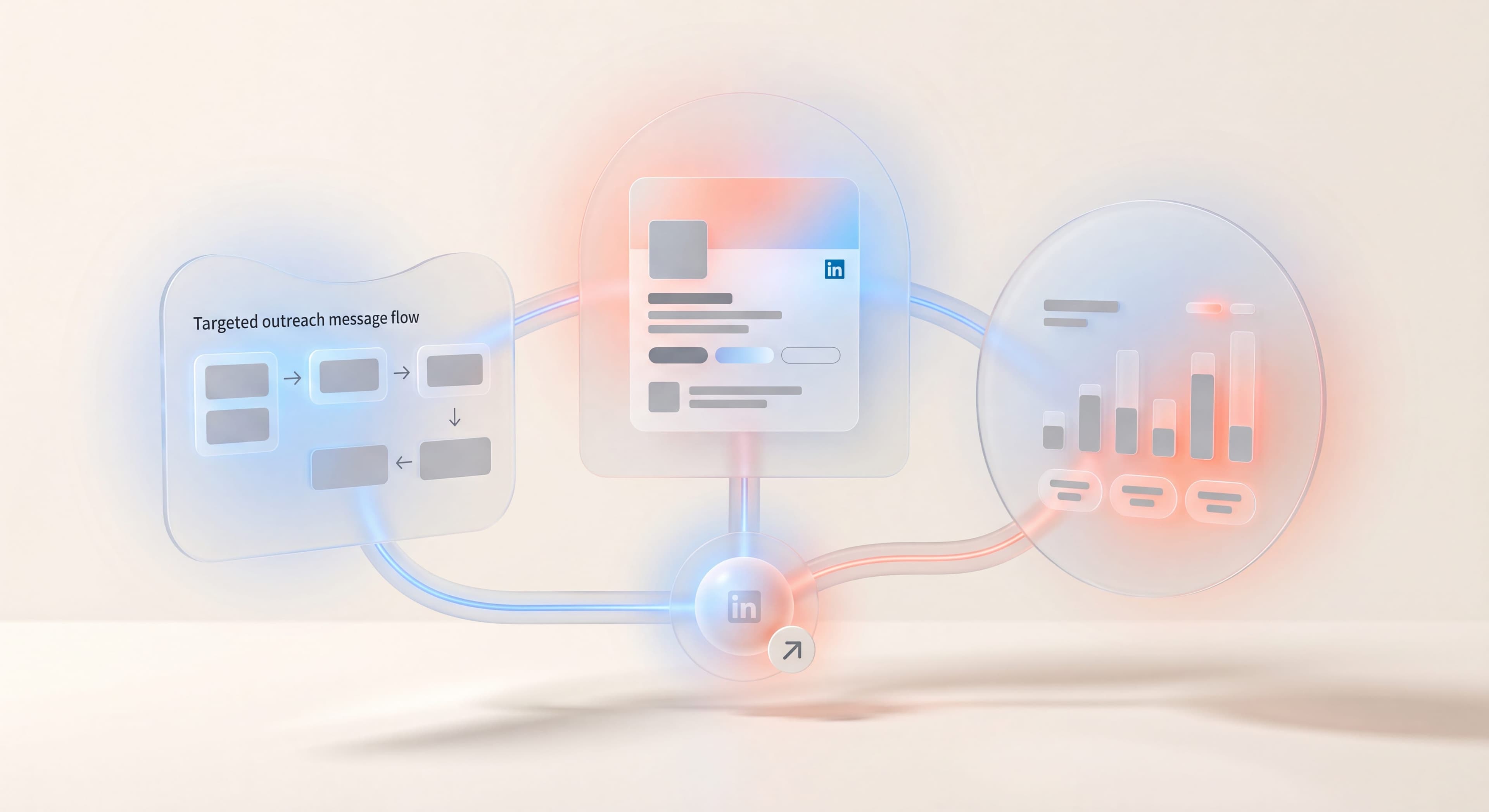
A LinkedIn lead generation strategy that works for B2B rests on three pillars: executive personal branding, targeted outreach, and LinkedIn Ads. At Moriah we run all three in parallel, in-house, pointed at a single business objective, because that's how LinkedIn actually performs. Here's what each one does, and why it needs the other two.
1. Executive personal branding
The highest-leverage move available to most B2B companies is putting their leaders' voices on LinkedIn, consistently and with a real point of view. Personal branding builds the credibility that everything else in your strategy leans on.
In practice that means publishing content from the personal profiles of your executives, not just the company page, at a steady cadence of one to three posts per week. The content should reflect genuine expertise: how you read your market, the problems you solve, the way you think about your customers' challenges. Decision-makers research quietly and form opinions about who's credible long before they ever raise a hand. Personal branding is how you land on that shortlist before the need is even spoken out loud.
On its own, personal branding produces awareness. That's worth having, but awareness alone isn't pipeline. Which is exactly why it pairs with the next pillar.
2. Targeted outreach
Targeted outreach is direct, qualified LinkedIn messaging to the specific decision-makers you want as customers. This is the pillar that turns visibility into real conversations.
The mechanics matter here. Effective outreach is not a blast to everyone with a relevant job title. It's a researched, qualified list of the right people, messaged in a way that's actually relevant to them, at meaningful volume. And the numbers favor the channel: cold email typically earns somewhere around 1 to 3 percent replies, while well-run LinkedIn outreach lands closer to 10 to 15 percent. The reason for the gap is credibility. When your prospect gets a message and checks the profile behind it, they find an executive with a clear point of view and a feed full of substance, not an empty shell. That's the personal branding pillar quietly doing its job for the outreach pillar.
Outreach with no content behind it gets ignored. Content with no outreach stays stuck at awareness. Together, they produce qualified conversations.
3. LinkedIn Ads
LinkedIn Ads amplify reach and capture demand, deployed when they serve the objective rather than by default. Paid is the accelerant, not the foundation.
LinkedIn's targeting lets you put your message in front of exactly the firmographic and role-based segments you care about, which is precisely what B2B needs. Used well, ads extend the reach of your best-performing content and put your offer in front of buyers who haven't engaged organically yet. Used in isolation, they tend to burn budget, because you're promoting to people who have no prior sense of who you are. Run alongside personal branding and outreach, the same ad spend works far harder, because the audience already recognizes the name.
Why the three pillars have to run together
The single most important idea in this entire LinkedIn lead generation strategy is this: the three pillars are not three separate programs you can buy à la carte. They are one engine.
We see the proof of this constantly. A client who publishes thoughtful content but activates nothing around it gets visibility and no business. A client who runs outreach with no content behind it gets ignored. A client who runs ads to an audience that's never heard of them wastes the spend. Each pillar has a failure mode, and the other two are what prevent it. For any business objective beyond pure awareness, you need all three working in coordination.
This is also where most agencies fall short. Plenty of firms do one of these things well. Some are excellent at personal branding but can't run outreach or ads. Others are outreach shops, or ad specialists, and nothing more. Moriah's approach, and the reason we built the firm this way, is to run all three as a single coordinated engine, in-house, so they actually reinforce each other instead of pulling in different directions.
How to build your LinkedIn lead generation strategy step by step
If you're putting together a LinkedIn lead gen strategy for an established B2B company, here's the sequence we'd recommend.
- Start from the business objective, not the tactics. Decide what you actually want LinkedIn to produce: qualified leads in a specific segment, a new partnership pipeline, entry into a new market, visibility with investors. Every other decision flows from this. Almost any business objective has an answer with the right LinkedIn strategy, but only if you name the objective first.
- Define the audience precisely. Identify the exact decision-makers you need to reach, by role, industry, and seniority. This single list drives both your content themes and your outreach targeting.
- Activate executive personal branding. Get your leaders posting from their personal profiles, one to three times a week, with content that speaks directly to that audience. This builds the credibility base.
- Layer in targeted outreach. Begin messaging your qualified list, at meaningful volume, with profiles that now have real content behind them. The two pillars reinforce each other from day one.
- Add LinkedIn Ads when they serve the objective. Amplify your strongest content and offers to the precise segments you care about, once there's organic credibility for the ads to build on.
- Measure pipeline, not vanity. Track qualified conversations and opportunities, not impressions and follower counts. The point of the engine is business outcomes.
The order matters more than it looks. Credibility comes before outreach, and organic comes before paid. Build the engine in that sequence and each pillar makes the next one work harder.
How Moriah runs LinkedIn lead generation for established B2B companies
Everything above is what we do for our clients, end to end. Moriah operates a company's LinkedIn presence as a LinkedIn lead generation business engine: we handle strategy, content production, the outreach itself, and the ads, all in-house, all coordinated toward the one objective the client cares about. It's a done-for-you managed service, not a course or a toolkit, and not a single-channel offering.
The engagement is built around proof. We do a deep discovery of your business and your objective, then run the three-pillar engine against it and measure what it produces. There's no lock-in and no minimum term: it's a no-commitment retainer you can cancel anytime, structured to give the strategy enough room to gather real data and show results. About half of the prospects who see the full approach become clients, and churn stays very low, because once the engine is running and producing conversations, companies tend to keep it running.
If your buyers are genuinely active on LinkedIn and you want it to produce business rather than just presence, that's exactly the situation Moriah is built for.
Frequently Asked Questions
What is a LinkedIn lead generation strategy? A LinkedIn lead generation strategy is a coordinated plan to attract and convert qualified B2B buyers on LinkedIn into sales conversations. It combines executive personal branding, targeted outreach, and LinkedIn Ads, aligned toward one business objective rather than run as separate activities.
How do I generate B2B leads on LinkedIn? Start by defining your business objective and the exact decision-makers you want to reach. Then publish credible content from your executives' personal profiles, message your qualified targets directly, and amplify your best content with ads. The leads come from running these together, not in isolation.
Why does posting from a personal profile matter for LinkedIn lead generation? Content published from a personal profile performs roughly 5 to 10 times better than the same content from a company page, because people engage with people rather than logos. Personal branding also gives your outreach credibility, since prospects check the profile behind any message they receive.
Is LinkedIn outreach better than cold email for B2B? For most B2B companies, yes. Cold email typically earns around 1 to 3 percent replies, while well-run LinkedIn outreach lands closer to 10 to 15 percent. The difference is credibility: a message that arrives next to a profile full of substance gets answered far more often.
How often should executives post on LinkedIn for lead generation? A cadence of one to three posts per week is enough to build authority and stay visible without overwhelming the audience. Consistency matters more than volume, and the content should reflect genuine expertise about your market and your buyers' challenges.
Do I need LinkedIn Ads to generate leads? Not always. Ads amplify reach and capture demand, but they work best layered on top of personal branding and outreach rather than on their own. Run to an audience that already recognizes your name, the same ad spend works much harder.
How long does a LinkedIn lead generation strategy take to produce results? It takes enough time to gather real data and prove what the engine produces, which is why the approach is built around measuring results rather than promising them. The pillars start reinforcing each other early, but qualified pipeline builds as the engine runs.
What's the difference between personal branding and outreach on LinkedIn? Personal branding is publishing content that builds your executives' authority and visibility, which produces awareness. Outreach is direct, qualified messaging to specific decision-makers, which produces conversations. Each underperforms alone, so an effective LinkedIn lead gen strategy runs them together.
Who should own a B2B LinkedIn lead generation strategy? The strategy should answer to a single business objective, so it needs one owner coordinating content, outreach, and ads rather than three teams each chasing a different metric. Many established companies outsource the execution to a specialist firm that runs all three pillars in-house.
Can LinkedIn really be a primary lead source for established B2B companies? Yes, when your buyers are genuinely active on the platform and you run a coordinated strategy rather than scattered tactics. For established B2B companies whose decision-makers are on LinkedIn, it can become a reliable engine for qualified pipeline, not just a place to maintain a presence.